Upon reading and analyzing the story “Heart Device May Be Useless for Women” for the first time, I ruled out a few different types of interactive graphics. I do not think that a map of any sort would be appropriate for this story, because it doesn’t mention any geographic locations other than in reference to where the quoted sources were from. I also ruled out simulations, instructive, and journalistic games, because this story doesn’t explain any processes. So, with the options I was left with, I decided that this article could benefit from a pie chart and a passive diagram.
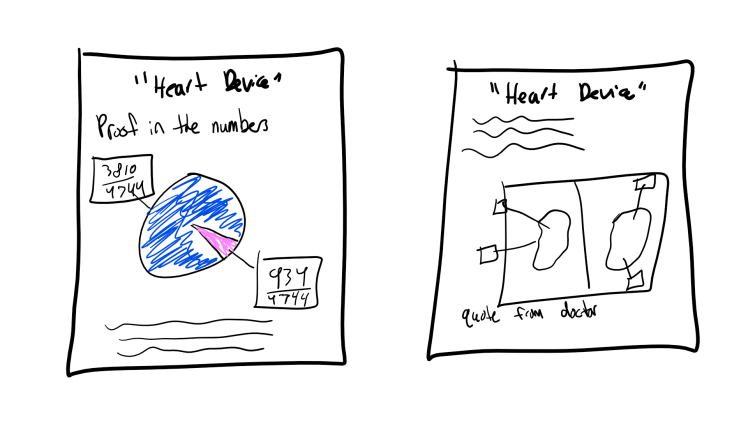
I would use the pie chart to display the number of men and women who were tested in the clinical trial that the article is referring to. The article wants the audience to believe that the trial may not have given an accurate representation as to how the ICD device works for women. This pie chart will give the viewers a visualization of how many more men were tested than women. I crunched the numbers and found that 80.3% of those in the trial were men, while 19.7% were women. This color-coded chart will show the numbers in an easy-to-understand way. It will display the percentages, and when the user rolls over the section, the exact number will appear.
The passive diagram will be a comparison of men and women’s hearts. This is based on the quote from the article, “’While unquestionably a woman’s heart is different than a man’s, nevertheless I would expect a heart in ventricular tachycardia or ventricular fibrillation to respond to appropriate therapy from an ICD regardless of sex,’ Zipes said when queried by MedPage Today and ABC News” (p. 3). It will show a side-by-side view of drawings of a man’s heart and a woman’s heart. It will have insets that point out the differences. In the introductory paragraph, it will talk about the aforementioned quote and explain that the purpose is to show the differences between male and female hearts so the viewer can understand why people would be concerned about the lack of women in the clinical trial. The drawings will be colorful and easy to understand, while still being anatomically correct. Users can click on parts of the hearts to get further information about them.
 COMM 340